Agenda, Minutes and Notice: Three Records, Three Jobs
Agenda, minutes and notice serve different public-record purposes. Learn which document fits your question and avoid treating one as a substitute.
The common mistake with an agenda, minutes and notice is treating them as interchangeable records of one meeting. That can leave you relying on a plan to claim what happened, or on a brief announcement to understand what the public body decided. Each document answers a different question, so start with the question you need answered.
Choose the record that fits your question
If you need to know what officials planned to discuss, look for the agenda. If you need to know what was recorded as happening, look for the minutes. If you need to know what the institution announced, including when or where an event would occur, look for the notice.
These records may refer to the same meeting, but they are not three versions of the same account. An agenda is forward-looking, minutes are retrospective, and a notice communicates information for a particular purpose. Reading the right one first saves time; checking another may be necessary to answer a different question.
- You are preparing to attend: Read the agenda for planned business, then check the notice for public access details.
- You are checking what was recorded afterward: Read the minutes, and compare them with the agenda if you need to see which planned items appear in the record.
- You are verifying an announcement: Read the notice itself and identify what it says, rather than inferring details from a later record.
- You are tracing a public decision: Use the minutes to locate the recorded proceedings, then consult any separate decision record or supporting document the minutes identify.
Use each document for the kind of claim it can support.
An agenda describes planned business
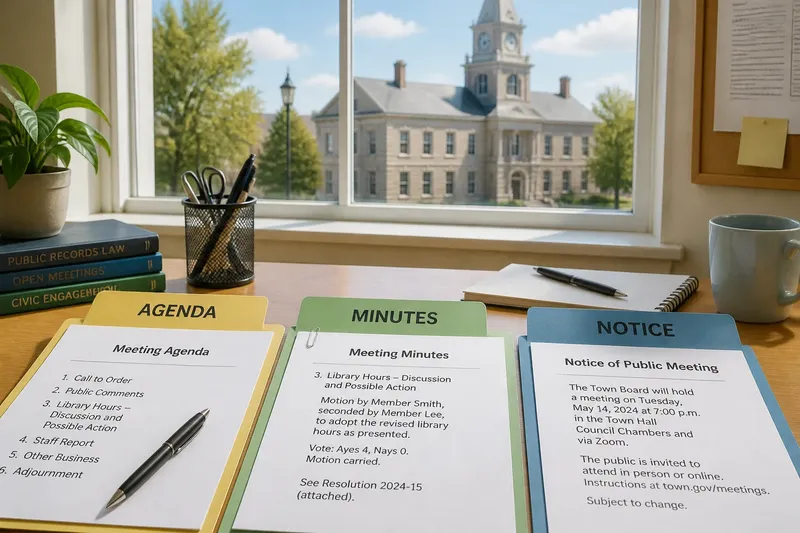
An agenda gives a meeting a sequence: items to be considered, reports that may be presented, and matters listed for discussion or action. Its wording can help you anticipate what may come before the body, but listing an item does not show that it was discussed or that any particular outcome followed.
Pay attention to the action words. “Discussion,” “report,” “hearing,” and “possible action” signal different expectations, though the exact meaning depends on the institution’s own conventions. A short item title may also point to a staff report, draft policy, map, or other attachment that supplies the detail the agenda omits.
Say you see “Library hours—discussion and possible action” on a town board agenda. That tells you the topic is planned for the meeting and that action may be considered; it does not establish that hours changed. To learn what the board recorded afterward, turn to the minutes and any separate resolution or adopted schedule cited there.
A notice communicates specific information
A notice is an announcement, not a full account of a meeting’s business or outcome. Depending on its purpose, it may identify a meeting, hearing, deadline, location, access method, or opportunity to submit comments. Its value lies in communicating those particulars to the people who need them.
Read the notice for its stated scope. A meeting notice may name the date and place without reproducing the full agenda; a notice about a public hearing may describe the subject and explain how participation is invited. Do not assume that a notice’s brief description contains every item, document, or later action related to the matter.
When a notice points to a separate agenda, attachment, or submission address, follow that reference to answer the next question. The notice tells you what was announced; the referenced record may provide the fuller context.
Minutes record proceedings, not every detail
Minutes document proceedings in the form the institution keeps as its official record. They commonly identify meeting business and actions, but they are not necessarily a word-for-word transcript. A concise entry may record that a motion was made and adopted without preserving every comment that led to it.
Look for the item title, any recorded motion or vote, and references to reports or attachments. If you need exact language from a resolution, the resolution itself may be clearer than a brief minute entry. If you need what a participant said, check whether a transcript, recording, or submitted statement exists rather than treating minutes as a complete conversation.
Minutes can also distinguish discussion from formal action, but the wording matters. An entry noting that members discussed a proposal is not the same as an entry recording adoption. Follow the record’s verbs and any linked document before describing the outcome.
Check the institution’s record rules when details matter
Document names and procedures can vary across public bodies. When the exact status, timing, access method, or legal effect matters, check the institution’s own instructions and applicable local rules, or ask a qualified professional where appropriate.
For an ordinary lookup, start with the institution’s meeting or records page. Search by the body’s name and meeting date, then compare the agenda, notice, and minutes as separate entries. File names and posting locations can be inconsistent, so confirm that each record refers to the same body and occasion before drawing a connection.
Which record should you use for each task?
Which record shows what a meeting planned to cover?
The agenda is the best fit because it lays out planned business. It does not prove that an item was reached, discussed, or acted on.
Which record shows what the body recorded after the meeting?
Use the minutes for the institution’s written account of proceedings. For exact wording or fuller context, look for a cited resolution, attachment, transcript, or recording.
Which record should I use to confirm a meeting announcement?
Use the notice for the information it actually announces, such as the stated time, place, or participation details. Consult the agenda if you also need the planned business.
Can one document replace the other two?
No single record does all three jobs. An agenda sets out plans, a notice communicates information, and minutes record proceedings; use each to support the claim it is suited to answer.
Keep your description as narrow as the record
When explaining what you learned, name the document and describe its limits. “The agenda listed a discussion” is more precise than “the board decided,” while “the minutes record adoption” identifies a recorded action rather than an announcement.
If you are sorting out a public-record question, agenda, minutes and notice are useful together precisely because they differ. Match the document to your question, then check another only when you need information that the first one was not made to provide.