Reading an Agenda Before a Meeting
Reading an agenda before a meeting helps you prepare for the right conversation, organize useful questions, and adapt if the schedule or materials change.
The most common mistake in reading an agenda before a meeting is preparing as if the listed item will unfold exactly as named. That can leave you with a speech for a discussion that gets postponed, narrowed, or redirected. A better approach is to prepare for the parts you can control: confirm the logistics, identify what you need to understand, and keep a flexible note ready.
Confirm the meeting details that affect your plans
Start with the meeting date, body, location, and format. A planning commission hearing, school board work session, and regular council meeting may all discuss local concerns, but they can offer different ways to listen or participate.
Check the institution’s meeting page for remote access instructions, public comment rules, sign-up requirements, and any deadline for written remarks. If the agenda links to a packet, open it now and save the page or file you need; do not count on finding it quickly during the meeting.
Write down one practical purpose for attending, such as understanding how a proposed street change affects your route. Keep that purpose separate from a prediction about what officials will do.
Build a flexible plan around the agenda
Read the full agenda once to understand its structure, then mark the items connected to your concern. Note nearby items that may provide useful context, but do not try to follow every line with equal attention.
Record the exact title of the item you care about and the agenda’s label for it, such as “report,” “hearing,” or “discussion.” These labels help you prepare for the scheduled format, but they are not a script for the room. An item may be delayed, combined with another, or handled in a different order.
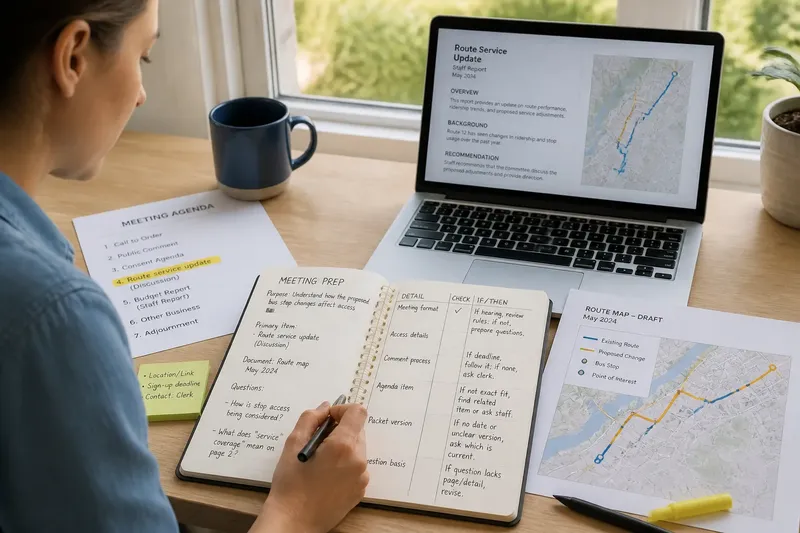
Say you are attending a transit committee meeting about a bus stop near your apartment. The agenda lists “Route service update” as a discussion item, and the packet includes a route map. You could note the map page, prepare a question about how stop access is being considered, and keep the rest of your evening flexible rather than assuming the committee will make a decision that night.
Choose one primary item and keep a short backup list. If the meeting moves quickly, you will know where to focus without treating the agenda’s order as a promise.
Use the documents to prepare, not predict
For your selected item, identify the current memo, draft, map, or presentation. Check its title, date, author, and version so you do not mistake background material for the document being discussed.
Read the beginning and ending of a memo first. The opening may explain the issue, while the closing may give a staff recommendation or describe options. A recommendation from staff is not the same thing as a decision by the board or committee.
For a map or table, check the legend, labels, and whether it depicts existing or proposed conditions. If a detail you need is missing, record the gap as a question instead of filling it with an assumption.
Keep your notes grounded in details you can point to: a page, map label, agenda line, or sentence. That makes it easier to adjust your question if the conversation takes an unexpected turn.
Turn uncertainty into questions
Separate what you do not understand into three kinds of uncertainty: an unfamiliar term, a missing fact, or a choice between options. Each calls for a different question. You might ask for a plain-language definition, request a missing detail, or ask how the group will compare the options.
Write down the specific word or passage and where it appears. “What does ‘service coverage’ mean in the map on page two?” gives a presenter something concrete to address; “Can you explain the packet?” is harder to answer usefully.
Keep observation apart from interpretation. “The route map marks the east entrance but not the bus stop” describes what you see. “The plan ignores riders” is a conclusion you may want to discuss, but first asking how stop access is represented can clarify what the map is meant to show.
What should you prepare before you go?
What is the item labeled as?
Copy the agenda title and format label into your notes. If the label or purpose is unclear, prepare to ask what the group expects to discuss or consider.
Which document will help you follow the discussion?
Write down the name and date of the relevant memo, map, or draft. If you cannot tell which version is current, ask the meeting organizer or staff which document participants will use.
What information do you still need?
Note whether the gap is a definition, a missing fact, or an unclear comparison. If the packet already answers the question, replace it with one about how that information relates to the item.
How can you participate if the format changes?
Check the posted comment instructions and note the organizer’s contact information. If the item is postponed or public comment is not available in the planned format, ask the institution how and when you may submit your concern.
Keep a compact note with decisions attached
A useful meeting note is short enough to scan while people are speaking. For each detail, record what you observe and what you will do depending on what you find:
- Meeting format: Check whether the notice says hearing, work session, or regular meeting; if it is a hearing, review the comment rules, and if it is not, prepare questions suited to discussion or reports.
- Access details: Check for a location or working remote link; if either is missing, contact the institution before relying on that option.
- Comment process: Check for sign-up instructions and deadlines; if a deadline applies, follow it, and if no process is stated, ask the clerk how to participate.
- Agenda item: Check the exact title and label; if it directly relates to your concern, make it your main focus, and if not, identify the closest related item or ask staff where the issue belongs.
- Packet version: Check the document date and title against the agenda; if they match the current item, cite that file, and if they do not, ask which version is current.
- Question basis: Check that each question points to a passage, page, or missing detail; if it does, keep it, and if it does not, rewrite it to name the information you need.
For instance, imagine the agenda names a neighborhood traffic discussion, but the packet contains an older map without a date. Your note could record the map title, the absence of a date, and the question, “Which map version will the group use?” If staff identifies a current map, follow that version; if no current map is available, ask when the updated material will be posted before commenting on its details.
What if the agenda or meeting format changes?
Should you check the agenda again?
Yes, especially if you plan to speak or the issue is time-sensitive. If the page shows a revised agenda or new attachment, update your notes; if the meeting is canceled, do not rely on the old schedule and check the institution’s notice for next steps.
What if your item is postponed?
Set aside questions that assume it will be discussed that night. Ask when the item is expected to return and whether updated materials or a new comment process will be provided.
What if the discussion moves beyond your question?
Listen for the point where your concern fits, then ask a concise question grounded in the current discussion. If there is no suitable opening, use the posted contact or comment process to follow up afterward.
Reading an agenda before a meeting is most useful when your preparation can change with the room. Keep the agenda title, the document you relied on, and your main unresolved question together; if the conversation shifts, those notes let you ask for clarification without pretending you knew in advance what the group would decide.